London
Fog, Bells, Timeless Street Life
Morning fog curls along the Thames as footsteps echo on wet pavement and the scent of coffee drifts from corner cafés.
Late spring and early autumn shine—wander Covent Garden, watch the clock at Big Ben, and tap an Oyster card to move with ease.
Discover now and begin your London story.
01 · Overview
Learn about London
London Overview
A Calm Guide to London: History, Culture, and Where to Start
History
London began as a small Roman port called Londinium in the first century and grew through medieval trade, imperial expansion, and repeated reinvention after disasters like the Great Fire of 1666 and the Blitz of the 1940s. Its story is one of accumulation: visible in archaeological layers, grand public buildings, and a civic life shaped by centuries of politics, commerce and migration.
Current status
Today London is a global city—an economic and creative centre that balances multinational finance and tech with thriving arts, education and neighbourhood communities. It remains busy and changeable; new developments push out from the Thames while familiar streets retain a sense of continuity that helps visitors orient themselves.
Local culture
The city's culture is intentionally uneven: polished West End theatres sit beside grassroots venues, formal clubs exist alongside day markets and community gardens. Londoners tend toward practical politeness and a dry wit; neighbourhood identity matters more than any single ‘London’ stereotype, so exploring boroughs like Camden, Brixton, Shoreditch or Richmond will show very different sides of the city.
Food
London’s food scene mirrors its diversity — from Indian and Bangladeshi curries in Brick Lane to modern British tasting menus and an abundance of street food markets. Pubs still matter as social anchors, but dining now ranges from quick, excellent multicultural options to inventive restaurants that reinterpret local ingredients.
Attractions
The British Museum
The British Museum houses world-class collections spanning human history. It’s an excellent place to see objects—like the Rosetta Stone and Parthenon sculptures—that tell broad stories of cultural exchange, but allow time: the collection is vast.
The Houses of Parliament and Westminster
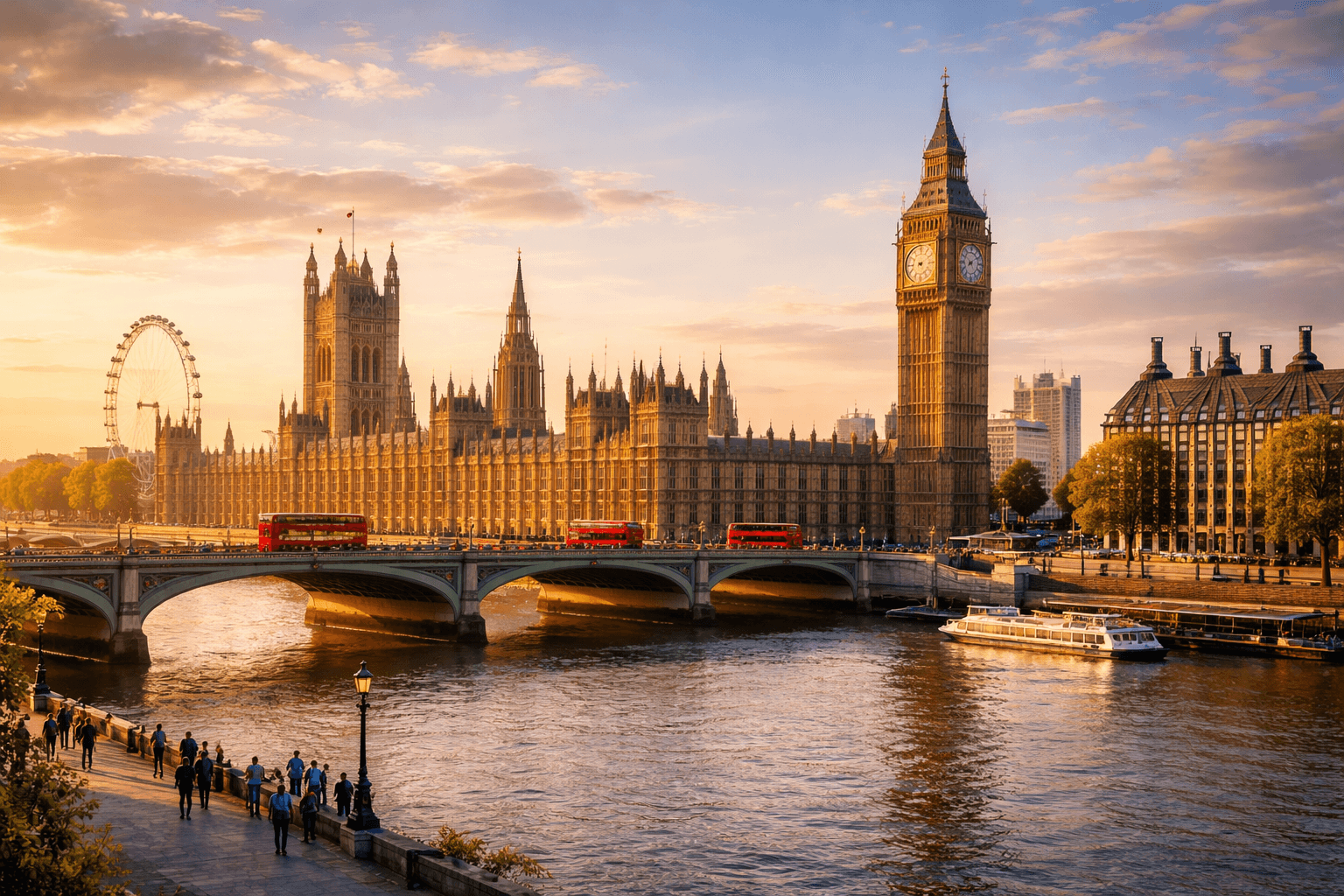
Westminster’s skyline and the River Thames combine political history and visual drama. Seeing the exterior and strolling nearby green spaces provides context for Britain’s constitutional story; guided tours of the interior are worth checking in advance if you want deeper insight.
The Tower of London and Tower Bridge
The Tower of London mixes fortress, palace and prison histories and still displays the Crown Jewels. Nearby Tower Bridge offers one of London’s most recognisable vistas and a chance to learn about Victorian engineering while walking its high-level walkways.
Tate Modern and the South Bank
Tate Modern repurposes industrial architecture into a leading modern art museum, and the adjacent South Bank is where Thames-side walks, performance spaces and year-round markets gather. It’s a good circuit for combining art with riverside cafés and street performances.
Royal Parks and palaces (Hyde Park, Buckingham Palace)
The royal palaces and parks offer breathing space and ceremonial tradition: Buckingham Palace for the pageantry, Hyde Park for relaxed walks or boating on the Serpentine. These sites are useful for pacing a sightseeing day—pick one palace or park rather than trying to do them all.
Markets and neighbourhoods (Borough Market, Camden, Notting Hill)
Markets like Borough and neighbourhoods such as Camden or Notting Hill are where everyday life and food converge: fresh produce, independent shops and secondhand finds. Plan visits outside peak meal times to enjoy them without the crush and to discover quieter streets nearby.
Final note
London rewards focused exploration: choose a borough or two and mix one major museum or landmark with local walks, a market visit and a pub or café. That balance shows both the city’s history and the present-day rhythms that make it liveable.
Places to Go
Buckingham Palace
Tower of London
British Museum
Things to Do
See the highlights along the Thames — South Bank walk
Visit the British Museum
Explore Borough Market and foodie streets
Take in a West End theatre show
Walk a neighborhood: Notting Hill or Shoreditch
Blogs to Read
50 Things To Do In London You Need To Try At Least Once In Your Life — Secret London
A well-curated list of 50 local favourites and offbeat experiences across London—markets, hidden museums, parks and neighbourhood food tips—useful for travellers who want both classic sights and lesser-known local spots.
London for visitors — Time Out (includes '101 great things to do in London')
A practical, updated visitor guide collecting Time Out’s best neighbourhood recommendations, must-see attractions and themed lists (including their 101 things to do), good for planning day-by-day and finding current events and food picks.
Eater London — London restaurant guides and neighbourhood food coverage
Focused coverage of London's dining scene—restaurant openings, neighbourhood guides, and curated lists—ideal for travellers prioritising where to eat, market stops and notable neighbourhood food scenes.
Londonist — Features, hidden gems and local culture in London
Local-focused stories, walking guides, quirky history pieces and hidden-gem roundups that help visitors explore neighbourhoods beyond the tourist trail and find practical tips on culture, markets and independent shops.
Love + London — neighbourhood guides and off-the-beaten-track recommendations
Run by a London-based writer/guide, the blog offers neighbourhood deep dives, honest restaurant recommendations and ideas for avoiding tourist traps—handy for travellers who prefer local eateries, markets and quieter routes.
02 · Find
Explore Local

We haven't mapped neighborhoods for London yet.
03 · Plan
Build Itinerary
Your trips
Your next trip starts here. Make a plan and find it here when you return.
Language Guide
04 · Travel Tips
Travel Tips
London — Practical Travel Tips
Local customs
- Greet with a brief "Hello" or "Hi"; people are polite but reserved.
- Queuing matters: stand in line and wait your turn for buses, trains, and counters.
- Tipping: round up or leave ~10–15% in restaurants if service isn’t included; small change or rounding up for taxis and cafés is fine.
- Mind personal space and low-volume conversation on public transport.
- Ask before taking photos of people in informal markets or of street performers.
Transportation options
- Oyster card / contactless bank card: cheapest and easiest for Tube, buses, trams, DLR, and some National Rail.
- Tube (Underground): fast for longer distances; avoid peak hours (roughly 07:30–09:30 and 16:30–18:30).
- Buses: extensive night and day coverage; use contactless/Oyster; bus drivers don’t give change.
- Overground and National Rail: often quicker for orbital trips and suburbs—check final destination and platform.
- Taxis: black cabs are metered; private hire (Uber, Bolt) must be pre-booked and vary in price.
- Cycling: Santander Cycle hire is available for short trips; follow bike lanes and wear a helmet if unsure.
- Airports: Heathrow and Gatwick are busiest; factor in extra time for airport transfers and security.
Safety
- London is generally safe, but watch for pickpocketing in crowded tourist areas and on public transport.
- Keep valuables secure and use a front pocket or money belt on crowded routes.
- Avoid poorly lit or deserted areas late at night; use licensed taxis or booked rides after dark.
- Emergency: dial 999 for police, ambulance, fire; 111 for non-emergency NHS advice.
- Check bags on trains and at stations; unattended luggage may be removed.
Insider tips
- Travel off-peak to save money and avoid crowds; museums often quieter on weekday mornings.
- Museum entry: many major museums have free general admission—book special exhibitions in advance.
- Plan walking routes: central London is walkable between many sights; wear comfortable shoes.
- Food markets: Borough, Maltby Street, and Camden offer good street food and local character—arrive earlier for best selection.
- West End shows: day-of discounted tickets available at TKTS-style booths or try last-minute apps, but book in advance for hit shows.
- Weather: layers are practical—rain is frequent and can be sudden even in summer.
- Currency: carry a small amount of cash for markets and small vendors; contactless cards accepted widely.
- Mobile data: consider a local SIM or international roaming plan for maps and contactless payments.
Travel light, give yourself time between connections, and enjoy the neighborhoods beyond the main tourist strip.