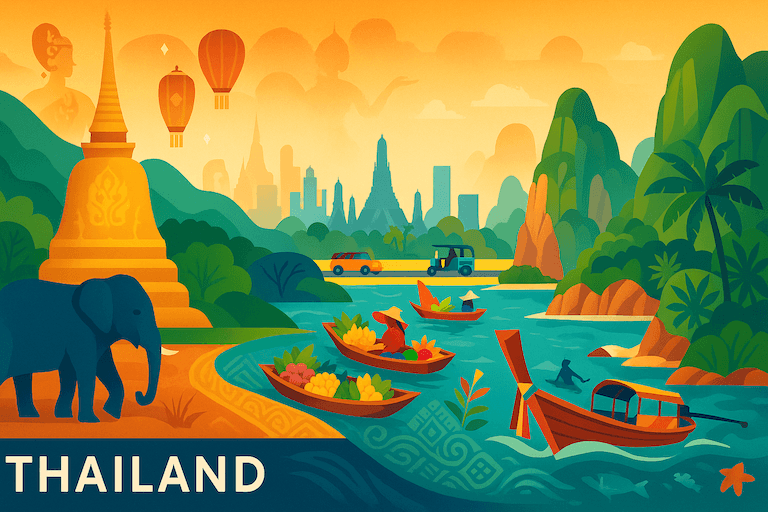
Thailand
Golden Temples, Tropical Nights
Warm air carries incense and street-food smoke as tuk-tuks hum past glowing temples and palms sway after rain.
November to February shines—wander Bangkok markets, taste pad thai, island-hop Phuket or Krabi, and dress modestly at temples.
Start your journey now and discover Thailand’s easy rhythm.
01 · Overview
Learn about Thailand
Thailand Overview
Thailand: A Concise Introduction to the Land of Smiles
History
Thailand’s story stretches back through ancient kingdoms—Dvaravati, Sukhothai and Ayutthaya—each leaving temples, inscriptions, and artistic traditions that shaped a distinct Thai identity. Unlike many of its neighbors, Thailand maintained independence through skillful diplomacy and selective modernization, which preserved royal institutions and a layered cultural continuity.
Current status
Today Thailand is a dynamic nation balancing modern urban growth with rural traditions: Bangkok pulses as a regional hub for finance, tourism and nightlife, while provinces remain rooted in agriculture and community life. Political currents and economic shifts influence daily life, but tourism, export industries and a lively creative scene continue to define its contemporary character.
Local culture
Thai culture centers on respect, family ties, and ritual—Buddhist temples, merit-making, and seasonal festivals shape social rhythms and communal ties. The wai (a slight bow with palms together) and a relaxed approach to time in many places reflect a polite, relationship-focused society that values harmony and hospitality.
Food
Thai cuisine is famously balanced: sweet, sour, salty, bitter and spicy often appear together in a single dish, from street-food classics to regional specialties. Markets and street stalls are the best classrooms for tasting local life—start with dishes like som tam (green papaya salad), pad thai, and a coconut-rich curry, and don’t miss regional variations when you travel between north, northeast (Isan), central and southern Thailand.
Attractions
Bangkok’s Grand Palace and Wat Pho
The Grand Palace complex and nearby Wat Pho showcase ornate temple architecture, gilded shrines and the Reclining Buddha—visual proof of Thailand’s royal and religious craftsmanship. These sites are compact cultural primers, best visited with time to absorb the details and the ritual life that surrounds them.
Ayutthaya Historical Park
The ruins of Ayutthaya speak to a once-powerful Siamese capital: crumbling prangs and banyan-entwined stupas create a haunting, photogenic landscape. A half-day or day trip from Bangkok lets you walk among centuries-old stones and imagine the city at the height of regional trade and influence.
Chiang Mai’s Old City and Temples
Chiang Mai blends a relaxed northern vibe with centuries of Lanna culture; its old city is ringed by ancient walls and dotted with serene temples and craft workshops. Beyond temples, the surrounding hills offer markets, trekking options and village crafts that reveal a different pace of Thai life.
Islands and Coastlines (Phuket, Krabi, Koh Samui, Koh Tao)
Thailand’s islands vary from limestone-cliffed Krabi and party-friendly Phuket to the quieter, snorkel-rich Koh Tao and palm-backed Koh Samui. Each island cluster has its own character—some for diving and calm bays, others for dramatic scenery or lively nightlife—so choose according to whether you want solitude, adventure or convenience.
Isan and Rural Northeast
The Isan region offers a rawer, less-touristed Thailand: rice fields, Khmer-influenced ruins, and hearty local food shaped by Lao and Khmer traditions. Visiting Isan gives perspective on agricultural life, regional festivals and culinary styles that differ markedly from the tourist trail.
Practical note
Check opening times and local customs before visiting temples and official sites, and be prepared to adjust plans for seasonal weather or festivals. Small choices—visiting early in the morning, sampling street food at busy stalls, or taking a local songthaew—make travel smoother and more rewarding.
Places to Go
The Grand Palace (Phra Borom Maha Ratcha Wang)
Wat Phra Kaew (Temple of the Emerald Buddha)
Historic City of Ayutthaya (Ayutthaya Historical Park)
Wat Arun (Temple of Dawn)
Phi Phi Islands (Ko Phi Phi)
Things to Do
Visit the Grand Palace & Wat Phra Kaew (Bangkok)
Explore Ayutthaya Historical Park (day trip from Bangkok)
Chiang Mai: Doi Suthep and Old City temples
Island hopping in the Andaman: Phi Phi / Phang Nga / Krabi
Bangkok street food and night markets
Blogs to Read
The Ultimate Bangkok Travel Guide for Food Lovers — Migrationology
Mark Wiens’ detailed, food-first guide to Bangkok covering street-food spots, markets, neighborhood recommendations, where to eat by dish, and practical transport tips—useful for travelers who want to eat well and navigate the city’s food scene.
Bangkok Travel Guide — Migrationology
A broader city guide from Migrationology with attraction highlights, neighborhood overviews, and food suggestions; good for combining sightseeing with local eating experiences and planning logistics.
Chiang Mai Travel Guide (Updated 2026) — Nomadic Matt
Practical, budget-minded guide to Chiang Mai with top things to do, where to eat, suggested itineraries, and money-saving tips—handy for first-time northern-Thailand visitors and budget travelers.
A 5-day beach-hopping itinerary in Thailand — Lonely Planet
Lonely Planet’s concise south-Thai itinerary focusing on islands and beaches, with recommended islands, timing, and local highlights—useful if you have limited time and want a curated route for beaches and island hopping.
Best Places to Visit in Thailand (2026 Guide) — Southeast Asia Simplified
A recent, comprehensive overview of top destinations across Thailand (cities, mountains, islands) with practical notes on what to do in each place and who it’s best suited for—helpful for planning a multi-region trip.
02 · Find
Explore Local

We haven't mapped neighborhoods for Thailand yet.
03 · Plan
Build Itinerary
Your trips
Your next trip starts here. Make a plan and find it here when you return.
Language Guide
04 · Travel Tips
Travel Tips
Thailand — Practical travel tips
Local customs
- Greet with a wai (palms together + slight bow); return one, or nod/smile for casual service staff. (maranotravel.com)
- Respect religion: cover shoulders and knees at temples, remove shoes before entering buildings, keep voices low, don’t point feet at Buddha images. (amazingthailand.com)
- Never insult the monarchy; be careful with jokes or social-media comments — lèse‑majesté is taken seriously. (visitthailandtoday.com)
- Small gestures matter: don’t touch people’s heads, avoid public displays of anger, and use polite language/tones. (visitthailandtoday.com)
Transportation options
- Domestic flights: fastest between regions (AirAsia, Bangkok Airways, Nok Air, Thai Lion Air). Book ahead for best fares; watch baggage rules. (lonelyplanet.com)
- Trains: comfortable overnight sleepers on main north/south lines for scenic overnight travel; book reserved berths for long trips. (wherebest.com)
- Long‑distance buses / VIP coaches: frequent, cheap, and reach towns without airports; use reputable operators for comfort. (wherebest.com)
- City transport: Bangkok — BTS (Skytrain) and MRT are fastest in peak hours; taxis and Grab are plentiful but insist on meter or use app. Phuket and many islands have little public transit — expect taxis, motorbike taxis, songthaews, or rental scooters. (thailandaddict.com)
- Ferries & speedboats: essential for islands; check seasonal schedules and sea conditions before booking. (wherebest.com)
Safety
- General: Thailand is tourist‑friendly but watch petty theft in crowded markets and transport hubs; keep valuables secure and use hotel safes. (travel.state.gov)
- Common scams: be wary of gem shops, unofficial “free” tours, and tuk‑tuk/van drivers offering odd side‑trips — agree price first. (travel.state.gov)
- Health: bring mosquito repellent, sun protection, and basic meds; make sure travel insurance covers medical evacuation. (oattravel.com)
- Emergency contacts: save local emergency/medical numbers (e.g., medical emergency 1669) and your embassy’s details. (thailand.prd.go.th)
Insider tips
- Pack a lightweight sarong or scarf — useful for temple visits, modesty, and sudden cool evenings on boats. (go2-thailand.com)
- Footwear: wear shoes easy to slip on/off for temples and markets. (thailandforamericans.com)
- Money: carry some cash (small notes) for markets and rural areas; major cities accept cards but check ATM fees. (wherebest.com)
- Rush hours: avoid Bangkok roads 7–9:30am and 4–7pm; use BTS/MRT or riverboats where possible. (lonelyplanet.com)
- Scooter rentals: common on islands; only rent if experienced, check helmet condition, and confirm insurance coverage. (thailandaddict.com)
- Respect local tempo: bargaining is normal in markets but do it with a smile; eating street food is safe in busy stalls with turnover. (wherebest.com)