
Introduction
The National September 11 Memorial & Museum (commonly called the 9/11 Memorial) sits at the World Trade Center site in Lower Manhattan. The outdoor Memorial—two large reflecting pools set in the footprints of the original Twin Towers—and the adjacent Museum honor the nearly 3,000 people killed on September 11, 2001 and February 26, 1993. It is both a place of remembrance and a public space for reflection, learning, and civic quiet.
The site is historically and culturally significant as a focal point for national mourning, resilience, and conversations about security, loss, and urban recovery. It appeals to history and civic-minded travelers, families of victims, students, and anyone seeking a thoughtful, educational experience.
Why Visit
- Pay respects to victims and understand the human impact of the events.
- See a powerful example of memorial design and urban recovery.
- Access museum exhibits that contextualize September 11 and 1993 bombing through artifacts, testimony, and timeline.
- Experience a contemplative public space in the heart of New York City.
Main Areas & What to See
Memorial Plaza (Reflecting Pools)
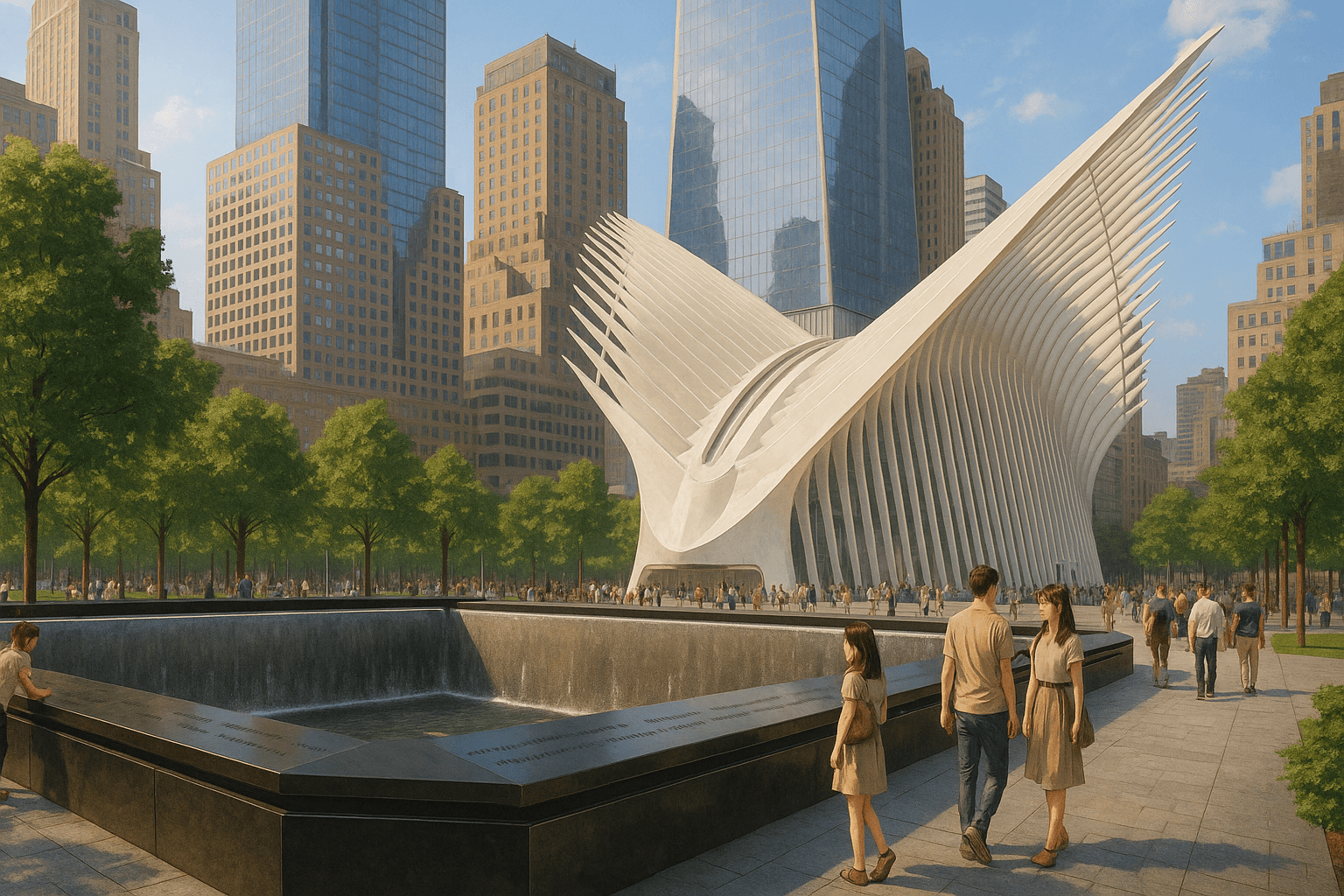
- What it is: Two large square pools with waterfalls sitting in the exact footprints of the Twin Towers, surrounded by bronze panels engraved with victims’ names.
- Why it matters: The pools mark absence and memory; the names personalize loss.
- What to notice/do: Walk the perimeter slowly, read names, look up to the surrounding plaza trees and architecture; maintain a respectful silence.
Survivor Tree
- What it is: A Callery pear tree that was recovered damaged from Ground Zero, nursed back to health, and replanted at the Memorial.
- Why it matters: Symbolizes resilience and recovery.
- What to notice/do: Pause to read the small plaque and consider the tree’s story of survival.
Memorial Museum (underground)
- What it is: A museum documenting the events, victims’ stories, artifacts (like structural beams, personal items), oral histories, and timelines.
- Why it matters: Provides historical context and personal narratives that deepen understanding beyond the outdoor Memorial.
- What to notice/do: Allow time for the chronological exhibits, visit the Foundation Hall and Memorial Hall, and follow exhibit signage; audio guides add context.
Liberty Park & St. Nicholas National Shrine
- What it is: Elevated park with views into the Memorial and the rebuilt St. Nicholas Greek Orthodox Church site nearby.
- Why it matters: Offers a quieter vantage point and speaks to community and spiritual rebuilding.
- What to notice/do: Use for reflection and photos; check visiting hours for the Shrine.
Oculus & World Trade Center Complex
- What it is: Transportation hub and shopping space adjacent to the Memorial.
- Why it matters: Architecture (by Santiago Calatrava) and the transit connection frame the Memorial within the living city.
- What to notice/do: Pass through for transit or to access nearby attractions like One World Observatory (separate ticket).
Best Time to Visit
- Time of day: Early morning (park opens before typical downtown rush) or late afternoon for thinner crowds and softer light. Evening visits after sunset offer a solemn atmosphere with illuminated pools.
- Crowd considerations: Midday and weekends are busiest, especially around anniversaries (September 11). Expect queues for Museum entry during tourist high season.
- Atmosphere differences: Mornings feel contemplative and quiet; afternoons are busier and more public; evenings are subdued and reflective.
Seasonal Highlights
- Spring: Trees and Memorial plantings bloom—pleasant weather for outdoor reflection.
- Summer: Warmer temperatures and high visitor volume; plan earlier or later visits to avoid heat and crowds.
- Fall: Crisp air and changing leaves add color to the plaza; September 11 anniversary events occur (higher visitation and ceremonies).
- Winter: Fewer tourists and a stark, quiet setting; check for holiday closures and colder conditions.
Practical Tips
- Cultural etiquette: Treat the site with respect—lower voices, avoid loud phone calls, and do not climb on memorial features. Dress appropriately for a place of remembrance.
- Photography rules: Photography of the outdoor Memorial is allowed for personal use; be respectful when photographing people and names. In the Museum, follow posted rules—some areas restrict tripods or flash photography.
- Payment, access, timing: The Memorial plaza is free and open to the public. The Museum requires a timed-entry ticket (purchase online recommended). Security screening is standard at entrances.
- Accessibility: The site and Museum are wheelchair accessible; wheelchair loaner requests and accessibility services are available—check official channels before visiting.
- Estimated visit duration: 30–60 minutes for the outdoor Memorial; plan 1.5–3 hours if visiting the Museum.
Getting There
- Nearest stations: World Trade Center station (PATH), Cortlandt Street (subway R), Fulton Street complex (subways 2/3/4/5/A/C/J/Z), and nearby Chambers Street and Rector Street stations. The Oculus connects several subway lines and PATH.
- Access points: Follow signage for the Memorial and Museum entrances; allow extra time for security lines.
- Typical travel time from Midtown Manhattan: 20–30 minutes by subway or taxi, depending on traffic and exact starting point.
Is It Worth It?
Yes—if you want a thoughtful, educational encounter with a pivotal moment in recent history. The outdoor Memorial is a powerful, quiet space for reflection that requires little time and no fee. The Museum adds depth and can be emotionally intense; allot adequate time and be prepared for difficult content. For respectful visitors seeking to understand the human stories and the city’s recovery, a visit is worthwhile.