
Introduction
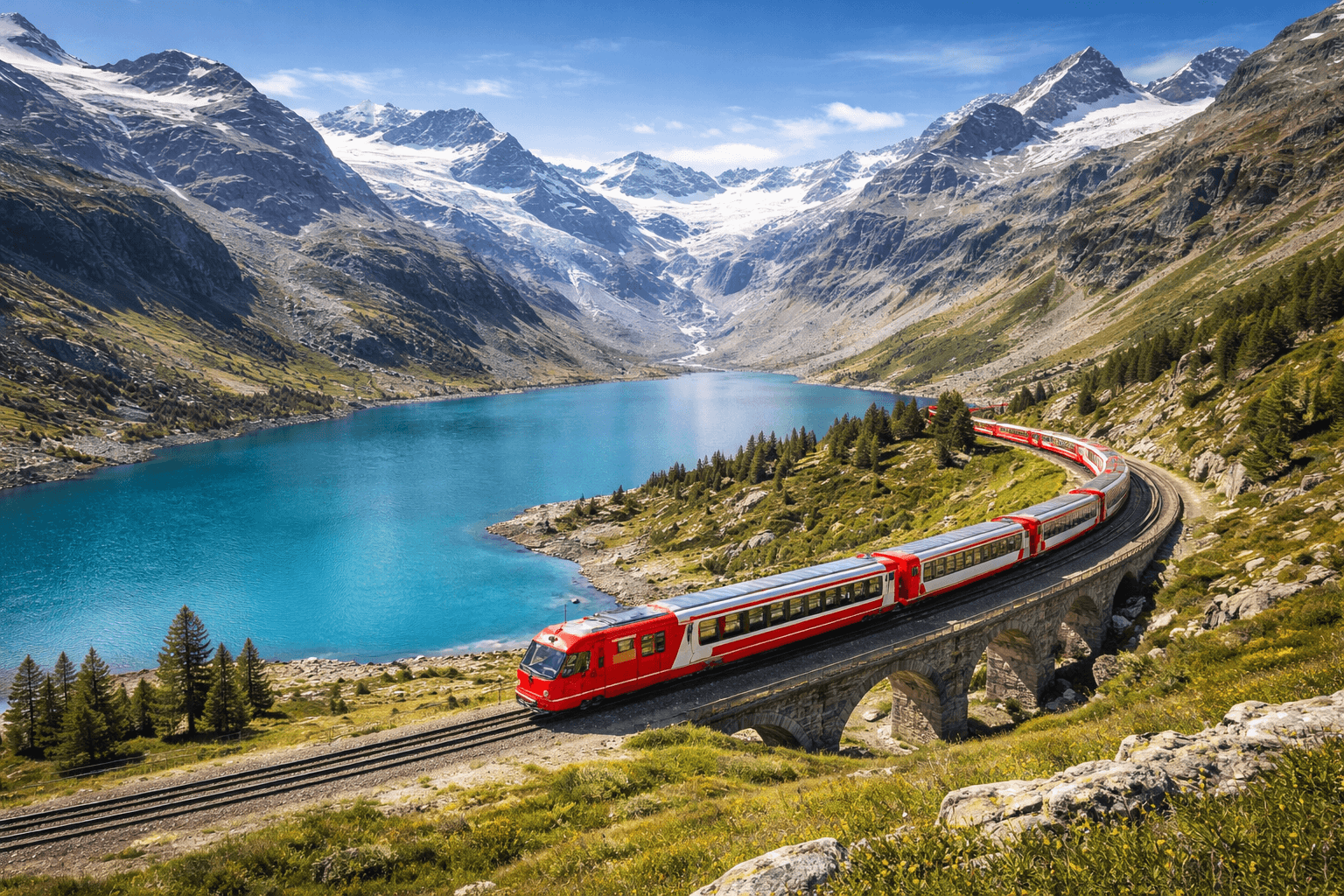
The Bernina Express is a panoramic train route through the Swiss Alps operated by the Rhaetian Railway. It links the Alpine towns of Chur and St. Moritz with Tirano in Italy, crossing dramatic mountain passes, UNESCO-listed viaducts and high-elevation glaciers. The journey is both an engineered-railway achievement and a moving scenic experience, valued for its dramatic landscapes and seamless Switzerland–Italy connection.
This place appeals to day-trippers, slow-travelers, photographers, railway enthusiasts, families, and anyone who wants a comfortable, low-effort way to experience high Alpine scenery without trekking.
Why Visit
- Uninterrupted panoramic views of glaciers, mountain passes and deep valleys.
- UNESCO-listed Bernina line engineering—viaducts, spirals and high-altitude track.
- Easy cross-border trip from Switzerland into Italy (Tirano) with cultural contrast.
- Comfortable, accessible travel suitable for non-hikers and multi-generation groups.
Main Areas & What to See
Landwasser Viaduct (near Filisur)
- What it is: A dramatic curved limestone viaduct spanning a deep gorge.
- Why it matters: Iconic example of Swiss railway engineering and a frequently photographed landmark.
- What to notice/do: Watch the train curve onto the bridge; stop in Filisur if your schedule allows for a short walk or viewpoint.
Ospizio Bernina & Bernina Pass
- What it is: The high point of the route, above 2,200 m, with stark alpine scenery and small mountain station.
- Why it matters: Offers close views of glaciers and high-mountain terrain with a near-arctic atmosphere.
- What to notice/do: Dress warmly, step out briefly at Ospizio Bernina for fresh air and photos (if conditions permit).
Morteratsch Glacier View (near Pontresina)
- What it is: Glacier views visible from the line and nearby stops.
- Why it matters: One of the most accessible glacier vistas in the region.
- What to notice/do: Consider a longer stay in Pontresina for glacier trails or a guided walk (seasonal).
Brusio Spiral Viaduct
- What it is: A circular stone viaduct that lets the train gain altitude in a compact footprint.
- Why it matters: Ingenious, photogenic solution to steep terrain—symbolic of the Bernina route.
- What to notice/do: Best photographed from nearby road viewpoints or from the train as it slowly descends.
Tirano (Italy) Terminus
- What it is: Charming Italian town at the end of the line with a historic square and local cafés.
- Why it matters: Cultural contrast—Swiss precision meets Italian atmosphere; good for lunch or an overnight.
- What to notice/do: Walk the Piazza Cavour, sample Italian espresso or regional food before returning.
Best Time to Visit
- Time of day: Morning departures give clear light on south-facing slopes; late afternoon offers golden-hour color on mountains. Choose daylight hours—the route is scenic most of the way.
- Crowd considerations: Peak season (summer school holidays and autumn foliage weekends) fills panoramic cars quickly—reserve early. Weekdays are generally quieter than weekends.
- Atmosphere differences: Clear, crisp mornings yield the best long-distance visibility; afternoons can bring clouds or mountain weather changes.
Seasonal Highlights
- Spring (Apr–Jun): Snow still caps high peaks; lower valleys begin to green. Fewer crowds, variable weather.
- Summer (Jul–Aug): Lush valleys, long daylight, accessible mountain walks from stops. Highest ridership—reserve seats.
- Autumn (Sep–Oct): Vibrant larch and deciduous color on slopes—best for photographers and fewer tourists after early October.
- Winter (Nov–Mar): Snow-covered panorama and a dramatic alpine mood; some stations/activities are seasonal—check local connections.
- Special events: Regional festivals occur in towns along the line (summer village festivals, autumn harvest events); dates vary by year.
Practical Tips
- Reservations and tickets: Reserve a panoramic-seat supplement for the Bernina Express during high season and for guaranteed window seats. Tickets can be booked via Swiss rail websites or at stations.
- Accessibility: Trains are generally accessible but check specific assistance needs and platform access in advance.
- Luggage: Space aboard is limited but sufficient for small-to-medium bags; store large suitcases in luggage racks or at stations if needed.
- Clothing: Layer up—temperatures at high altitude can be several degrees cooler and windier than valley towns.
- Photography: Big windows allow excellent photos; avoid flash and be mindful of other passengers. If you stand in vestibules, take care when the train moves.
- Payment: Swiss francs in Switzerland; euros in Tirano—cards are widely accepted but carry some cash for small purchases.
- Estimated visit duration: Full route St. Moritz–Tirano ~4 hours one-way (Chur–Tirano ~4–4.5 hours). Plan 1/2 day for a single-direction scenic trip, or a full day if you include time in stops such as Tirano or St. Moritz.
Getting There
- Nearest major stations: St. Moritz station (engage with Bernina line), Chur station (historical start point on some services), and Tirano (Italian terminus).
- Typical travel time from city centers: From central St. Moritz station the Bernina Express departs from the town center—expect minimal transfer time. From Chur city center to Tirano via Bernina Express is roughly 4–4.5 hours depending on service; St. Moritz–Tirano is roughly 4 hours. Arrival/departure times and connections vary—check schedules the day before travel.
Is It Worth It?
Yes—if you value relaxed, scenic travel and want to cross high Alpine landscapes without a long hike. The route rewards travelers with dramatic views, engineering landmarks and a gentle way to experience both Swiss and Italian mountain cultures. For travelers on tight schedules, a single-direction trip or a short stop in Tirano delivers most highlights; for slow-travelers, combining the ride with overnight stays in St. Moritz or Tirano deepens the experience.